








Caravan LED lighting covers two jobs: 12V interior fittings, meaning downlights, reading lights and strips, and weather-sealed exterior lighting for the awning. Fit warm white inside living areas, natural white over the kitchen bench and bathroom, and a bi-colour amber and white awning light rated IP65 or IP67 outside. Amber attracts far fewer insects, and a full LED conversion cuts lighting draw by about 75 per cent against halogen.
- Warm white, 2700K to 3000K, suits the bed head, dinette and entry step. Natural white, about 4000K, suits the kitchen bench and bathroom.
- Cool white above 5000K is harsh at night and attracts the most insects. Keep it for the boot and storage.
- Awning lights must be rated IP65 or IP67 under IEC 60529. A bi-colour fitting at 8W and 800 lumens covers both setting up and evening use.
- Amber light attracts far fewer flying insects than blue-rich cool white, according to UCLA and Smithsonian research.
- Draw is small: a 2W reading light is about 0.17 A at 12V, an 8W awning light about 0.67 A. LEDs use about 75 per cent less energy than halogen.
- Caravan electrical work is governed by AS/NZS 3001.2:2022. Twelve-volt work is extra-low voltage and needs no licensed electrician, but 240V does. Look for the Regulatory Compliance Mark when buying.
Buy by zone rather than by product type. Match each area of the van to the fitting and colour temperature below, then add one bi-colour light for the awning.
| Where it goes | Fitting to buy | Colour temperature |
|---|---|---|
| Bed head | Reading light on a flexible neck, ideally with a USB outlet | Warm white |
| Dinette and lounge | Two or three recessed downlights on a dimmer | Warm white |
| Kitchen bench | Downlights plus an LED strip under the overhead lockers | Natural white |
| Bathroom | One downlight | Natural white |
| Boot, tunnel and wardrobe | Switched or sensor light so it cannot be left on | Cool white |
| Entry step and door | Door or step light, sensor switched | Warm white |
| Awning and annex | Bi-colour amber and white light, IP65 or IP67 | White, then amber at night |
Most caravan lighting upgrades are not one light. A typical interior conversion is six downlights, two reading lights, a strip under the lockers, a dimmer and an awning light. Buying the set at once means one delivery, one matched colour temperature and no second order when you realise the ceiling and the bed head do not match.
Interior lighting is about comfort and colour temperature. Awning lighting is about weather sealing, insects, and not glaring into the next site.
| Inside the caravan | Under the awning |
|---|---|
|
|
Use warm white downlights and reading lights in living and sleeping zones, natural white over task areas, and switched or sensor lights in storage. Lighting a caravan by zone stops you over-lighting the ceiling and under-lighting the bench.
Bed head. Two caravan reading lights on flexible necks, warm white. A caravan LED reading light with USB built in removes the need for a separate charging point at the bed.
Dinette and lounge. Two or three recessed downlights on a dimmer. This is the zone people most often over-light, and a dimmer fixes it for the price of one switch.
Kitchen bench. Natural white downlights plus a 12V LED light strip under the overhead lockers. Task light on the bench matters more than ceiling light here.
Choosing a strip. An LED strip light for a caravan comes as COB or SMD. COB puts the diodes in a continuous line so there are no visible dots, which suits a bench or an awning rail.
SMD is cheaper and brighter per metre. Both come as 12V strip light on a reel you cut to length.
Either looks better mounted in an aluminium channel, which hides the reel and spreads the light instead of throwing a row of bright points at the ceiling.
Boot, tunnel and wardrobe. A switched or sensor-activated light. A caravan sensor light cannot be left on, which matters in a space you close the door on.
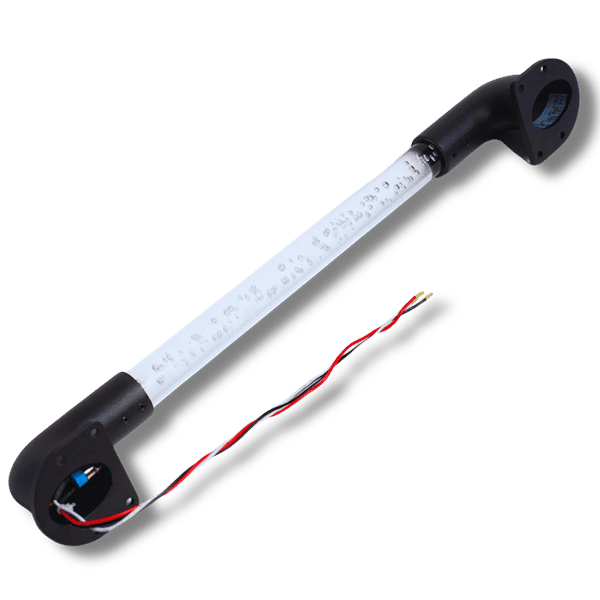
Entry step and door. A caravan door light or step light, warm white. A caravan grab handle with light built in covers the handle and the step in one fitting, which saves drilling a second hole.
Browse caravan interior lights, LED strips and switches and dimmers at HiTech Power Solutions.

A bi-colour amber and white LED light rated IP65 or IP67, with a wide beam and a voltage range that tolerates 12V to 28V. Amber for the evening, white for cooking and packing up.
IP65 versus IP67. Both are dust-tight. Under IEC 60529, the second digit is what differs: IP65 withstands water jets from a nozzle in any direction, while IP67 withstands temporary immersion to one metre for 30 minutes. Either is suitable outdoors. IP67 gives more margin on a van that gets hosed down.
The ratings are not cumulative. A fitting tested to IP67 has passed the immersion test, not necessarily the water-jet test. If both matter, look for a dual rating such as IP66/IP68.
Why bi-colour matters. Research by UCLA and the Smithsonian, published in Insect Conservation and Diversity, found that yellow and amber filtered LED light attracts far fewer flying insects, while blue and ultraviolet light attract the most.
Switching to amber after dark is the single most effective change you can make to the awning area, and it keeps your light out of the next site as well.
As a real example, the HiTech bi-colour awning and annex light runs 12 white 1W SMD LEDs and 12 amber 0.5W SMD LEDs in one 287 mm housing. It is rated 8W, 800 lumens, 12V to 28V, IP67, in a polycarbonate housing with a 40 cm tail.
Beyond the awning. Caravan exterior lights also cover the entry area. A caravan porch or outdoor light at the door, and an awning LED strip light along the awning roll, finish the outside of the van. Every caravan external light needs the same IP65 or IP67 rating as the awning fitting.
See the full range of awning and annex lights and caravan outside lights at HiTech Power Solutions.
Warm white, 2700K to 3000K, for living and sleeping areas. Natural white, about 4000K, for the kitchen bench and bathroom. Keep cool white above 5000K for the boot and storage only.
Colour temperature is measured in kelvin. Lower numbers look warmer and more orange. Higher numbers look bluer and closer to midday daylight.
The mistake that makes a caravan feel like a workshop is fitting cool white everywhere. It is bright, it is cheap, and at night it is harsh, unflattering and attracts the most insects when used anywhere near an open door.
Mixing is fine, provided you mix by zone rather than at random. Two different colour temperatures in the same ceiling will always look like a mistake.
Very little. A 2W reading light draws about 0.17 A at 12V, and an 8W awning light about 0.67 A. A normal evening of lighting uses roughly 3 to 4 amp-hours, which is a few per cent of a typical lithium battery.
The calculation. Divide the fitting wattage by 12 to get amps. Multiply by the hours you run it. Add the fittings together to get amp-hours per night.
Worked example using published HiTech figures. Two reading lights at 2W each, run two hours, use 0.68 Ah. One 8W awning light run four hours uses 2.68 Ah. That evening totals about 3.4 Ah.
On a 200 Ah LiFePO4 battery with roughly 160 Ah usable, that evening costs about two per cent of the bank. Add six ceiling downlights and the total is still small against a fridge, which is the load that actually empties a caravan battery.
| Fitting | Rated power | Current at 12V | Five hours a night |
|---|---|---|---|
| HiTech 12V reading light | 2 W | About 0.17 A | About 0.85 Ah |
| HiTech bi-colour awning light | 8 W | About 0.67 A | About 3.35 Ah |
Current figures are calculated from the published wattage of these two HiTech fittings. HiTech does not publish a wattage for its 60 mm and 76 mm downlights, so those are not included. Check the wattage printed on any fitting you buy and apply the same calculation.
Why this matters more than it looks. The Australian Government states that LEDs use about 75 per cent less energy than halogen globes and last five to ten times longer.
Converting an older van from halogen or fluorescent removes a meaningful share of the nightly draw, which is what turns two nights off grid into three. Pair the savings with a LiFePO4 battery and solar panels and the gain compounds.
In most older caravans, you can reuse the existing switch and wiring. The circuit is already 12V, so a caravan LED light conversion is usually removing the old fitting, checking the cutout, and mounting an LED fitting in its place.
Two jobs get confused here. Swapping caravan LED light globes or bulbs into an existing housing is a globe change. Replacing the whole housing with modern caravan LED interior light fittings is a conversion, and it is the one that actually changes how the van looks.
Step 1. Isolate the circuit. Turn off the lighting circuit at the fuse box or switch panel before removing anything.
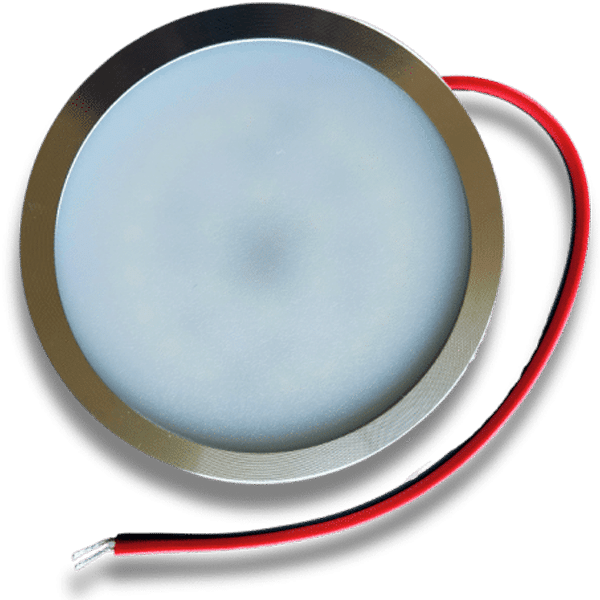
Step 2. Measure the cutout or footprint. Recessed downlights need a matching hole. Common caravan sizes are 60 mm and 76 mm. Measure before ordering, because a smaller replacement leaves a visible gap.
Step 3. Match the mounting type. An old fluorescent batten or a yellowed caravan oyster light has a larger footprint than a modern downlight. For a caravan oyster light LED replacement, a surface-mount fitting of similar size avoids patching the ceiling.
Step 4. Check polarity and reconnect. LEDs are polarity sensitive. If a new fitting does not light, reversing the two wires is the first thing to check.
Step 5. Convert the whole ceiling at once. Replacing two lights at a time produces a ceiling with mismatched colour temperatures. Do the ceiling as one job with fittings from the same range.
💡 Tip: a yellowed diffuser is what dates an interior, not the light itself. Older fluorescent and oyster diffusers go yellow and brittle with UV exposure. Replacing them with modern LED fittings changes how the whole van reads far more than the brightness gain does.
Yes, for the 12V side. Twelve-volt lighting is extra-low voltage, up to 120V ripple-free DC, and sits outside the licensed electrical work that applies to mains wiring. Anything at 240V is a licensed electrician’s job.
The installation still has to comply with AS/NZS 3001.2:2022, Electrical installations – Connectable electrical installations and supply arrangements, Part 2, which is the standard governing caravan and RV electrical work.
Every lighting circuit needs an appropriately rated fuse or circuit breaker on the battery side, and cable sized for the run length. Energy Safe Victoria states that unqualified electrical work is both dangerous and illegal. Check the rules in your own state and your insurer’s position before starting, and use a licensed electrician for any 240V work.
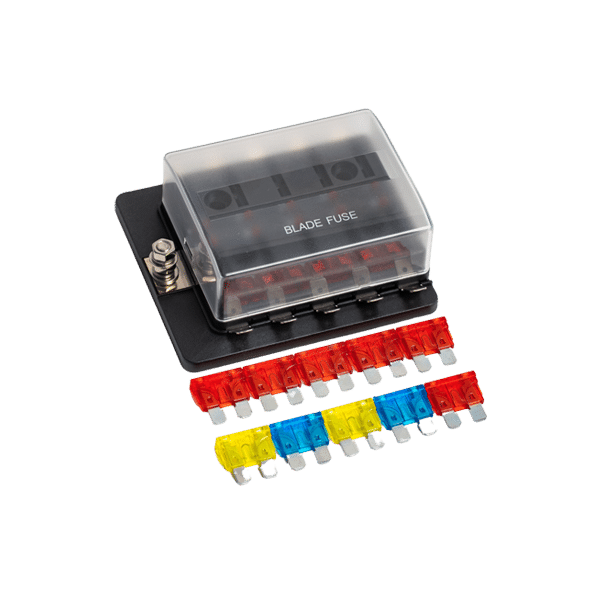
Fuses, breakers and isolators are in the circuit protection range, and 12V outlets in power points and switches.
Check the IP rating, the voltage range, the colour temperature, the cutout size and the compliance marking. Price differences between hardware-store fittings and caravan-specific ones usually come down to those five things.
The honest difference between a generic hardware-store 12V light and a caravan-specific one is rarely brightness. It is the voltage tolerance, the ingress rating, the published colour temperature and whether anyone will replace it in two years.
A caravan LED light kit is typically six downlights, two reading lights, an LED strip, a dimmer and one awning light kit. Buying the set together keeps the colour temperature consistent and usually clears the free shipping threshold.
| Item | Typical quantity | Purpose |
|---|---|---|
| 12V LED downlights | Six | Main ceiling lighting through the van |
| Reading lights | Two | Bed head task light, ideally with USB |
| LED strip | One to two metres | Under the overhead lockers at the bench |
| Dimmer or touch switch | One | Control on the main ceiling circuit |
| Boot or storage light | One | Switched or sensor light in the tunnel boot |
| Bi-colour awning light | One | Outdoor living area, amber after dark |
| In-line fuse or breaker | One per circuit | Circuit protection on the battery side |
HiTech ships Australia-wide with free shipping on orders over $100, which a full interior conversion clears comfortably.
Yes. Motorhomes, campervans, camper trailers, pop-tops, hybrid campers, 4WD canopies and boats all run the same 12V DC lighting circuits, so the fittings, colour temperatures and IP ratings carry across unchanged.
The only difference is quantity and space. A campervan needs fewer fittings and often favours surface-mount over recessed, because there is no cavity above the lining.
The same fittings work as 12V LED camping lights in a canopy, tent or annex, provided anything exposed to weather carries an IP65 or IP67 rating. A caravan LED lights replacement job on an older camper follows the same steps as the conversion above.
Road-legal lighting is a separate subject. Tail lights, clearance lights, side markers and number plate lights are governed by the Australian Design Rules and must not be replaced with general-purpose LED fittings. This article covers interior and awning lighting only.
HiTech Power Solutions is an Australian specialist in caravan, RV and off-grid electrical and electronic systems, supplying 12V lighting, switches and dimmers, LED strips, lithium batteries, solar, chargers and integrated POWERSYNC power management. Talk to the team about specifying a full interior and awning lighting set in one order.
Most single-axle caravans use four to eight ceiling downlights, depending on layout and whether the dinette and kitchen have their own. Spacing matters more than count, because evenly spaced fittings on a dimmer give better light than a few bright ones. Add reading lights at the bed head separately.
Only if the fitting is dimmable. Many 12V LED fittings are not, and pairing one with a dimmer can cause flicker or buzzing. Check the product specification first, then choose a PWM or touch dimmer rated for the total wattage on that circuit.
The usual cause is voltage drop on a long 12V run, which worsens as the battery discharges. Undersized cable is the second cause. Check the voltage at the fitting rather than at the battery, and check connections at both ends. A fitting rated 12V to 28V tolerates supply variation better.
Some are fine. The risks are a narrow voltage rating that does not tolerate charging voltage, an IP rating too low for outdoor use, and no published colour temperature, which makes matching the ceiling impossible. Look for the Regulatory Compliance Mark and a stated voltage range first.
They attract far fewer, which makes a noticeable difference. Research by UCLA and the Smithsonian found yellow- and amber-filtered LEDs attract fewer flying insects than blue and ultraviolet-rich light. Amber does not repel insects, so it will not clear an area already swarming, but it reduces how many arrive.
Not for 12V work, which is extra-low voltage. A competent owner or auto electrician can fit 12V lighting, provided the installation complies with AS/NZS 3001.2. Any 240V work, including mains lighting circuits, must be done by a licensed electrician.


$34.32 + GST

$37.20 Original price was: $37.20.$29.76Current price is: $29.76. + GST


$16.50 + GST
Fill out the form below, and we’ll get back to you as soon as possible.
Dear Valued Customer,
We will be closed for operations from 19 December to 29 December.
All orders placed between 19 December and 29 December will be processed and delivered after 29 December.
Our technical team, communications team, and customer support will also resume contact after 29 December.
Wishing you a Merry Christmas and a Happy New Year!